
By Lillian Lau, APA Titled Musculoskeletal Physiotherapist and Practice Principal, Annandale Physiotherapy & Sports Injury Clinic. M.Man.Thpy, BAppSc(Phty).
The short version
- A fine, single-use needle reaches deep muscle that hands cannot easily get to.
- It works on three levels at once: locally, at the spinal cord, and in the brain.
- The evidence supports short-term pain relief. It is a bridge into your exercise program, not a treatment on its own.
- It is faster than hands-on release, so more of your session goes into the work that lasts.
- Nobody should needle you without asking first. Every time.
Dry Needling: What Actually Happens and Is It Safe?
Dry needling is a treatment technique used by some physiotherapists to help manage musculoskeletal pain, muscle tightness and trigger points. But what actually happens when the needle goes in, why would you use it instead of hands-on treatment and is dry needling safe?
Here is the honest explanation.
What actually happens in a dry needling session?
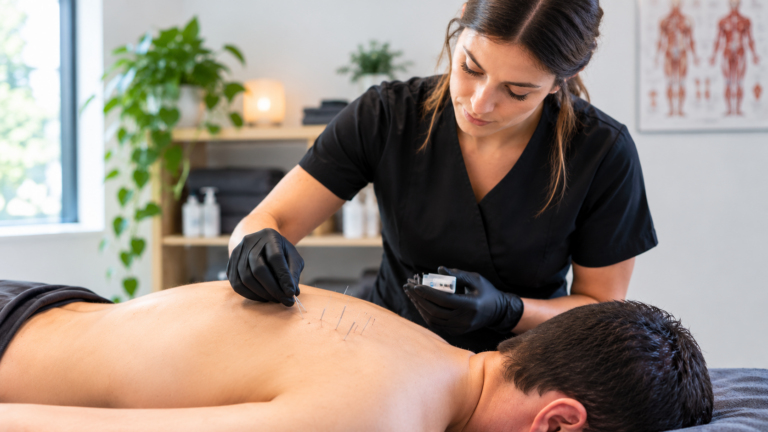
A very fine, sterile, single-use needle is inserted into a specific area of muscle or soft tissue, often targeting a tight muscle or trigger point.
Two techniques are commonly used. One involves a gentle pistoning movement of the needle within the tissue. The other targets a trigger point directly, sometimes producing a small involuntary muscle twitch.
The aim isn’t simply to “release” a muscle. Dry needling can influence the sensitivity of the area, the nervous system and the way the body responds to pain.
How does dry needling work?
This is the question I get asked most. The answer is more complicated than simply saying that the needle “releases a knot”.
There appear to be several things happening at different levels.
At the needle
When the needle interacts with the surrounding tissue, it triggers changes within the cells and can increase local blood flow. The body also releases natural chemicals, including adenosine, which may contribute to pain relief.
At the spinal cord
Needling stimulates nerves that can activate the body’s natural pain-blocking system. This can reduce the strength of pain signals travelling through the spinal cord to the brain. This may help explain why needling one area can sometimes reduce pain over a broader region.
In the brain
Needling can also activate the brain’s natural pain-control system. This can encourage the release of chemicals such as endorphins, serotonin and noradrenaline, which can help reduce pain.
There is an important limitation to this explanation. Much of the research into the exact mechanisms comes from animal studies and from electrical dry needling, which is different from a standard dry needling session. These mechanisms provide a plausible explanation for how needling may work, rather than proof that every one of these processes happens in every patient.
What the human research tells us is more straightforward: dry needling can help reduce musculoskeletal pain, particularly in the short term, while evidence for lasting benefits from needling alone is less convincing.
That is why I see dry needling as a tool within physiotherapy rather than the treatment itself.
Is dry needling the same as acupuncture?
Similar needles, different practice.
Acupuncture is a traditional Chinese medicine practice with its own theoretical framework, including concepts such as meridians and energy flow.
Dry needling is based on Western musculoskeletal anatomy. The aim is to target specific muscles, trigger points or other tissues as part of a broader physiotherapy treatment plan.
You may hear dry needling described as “Western acupuncture”. The terminology can be debated, but from a patient’s perspective, the important difference is the clinical framework and purpose behind the treatment.
Why use a needle instead of hands?
Sometimes a needle can reach tissue that is difficult to treat effectively with hands-on techniques.
Some muscles sit underneath several layers of tissue. Trying to reach them with a thumb or elbow can require a lot of pressure and may be uncomfortable.
A needle can access deeper tissue more directly and, for some people, can actually be more comfortable than sustained deep manual pressure.
It can also be time-efficient. Rather than spending most of an appointment performing hands-on treatment, needling may allow us to spend more time on assessment, exercise prescription and movement-based rehabilitation.
For people with very high muscle tone, where deep manual treatment is particularly uncomfortable or difficult, dry needling can be a useful additional tool.
Is dry needling safe?
Mostly yes, but I want to answer this properly rather than just reassure you.
Dry needling is generally considered a safe treatment when performed by an appropriately trained physiotherapist. However, like any treatment involving a needle, it does carry some risks.
The everyday risks are usually minor: post-treatment soreness, a small amount of bleeding or bruising, and occasionally feeling tired or lightheaded. These effects are generally short-lived.
There are also rare but more serious complications. One of the best-known is a pneumothorax (collapsed lung) when needling around the ribcage, upper back or shoulder region. This is uncommon, but it is a recognised risk because the lungs can sit relatively close to the surface in these areas.
This is why who is holding the needle matters. Safe dry needling requires additional training, a good understanding of anatomy, appropriate needle placement and depth, good hygiene, and careful consideration of whether the treatment is suitable for the individual.
Research involving more than 20,000 dry needling treatments found that minor side effects such as bleeding, bruising and temporary soreness were relatively common, while major adverse events occurred in less than 0.1% of treatments.
Boyce, D., Wempe, H., Campbell, C., et al. (2020). Adverse Events Associated with Therapeutic Dry Needling. International Journal of Sports Physical Therapy, 15(1), 103–113.
So, while dry needling isn’t completely risk-free, serious complications are rare.
Not every physiotherapist does dry needling
Dry needling is not part of the standard physiotherapy degree.
Physiotherapists who use dry needling undertake additional post-graduate training. Plenty of excellent physiotherapists don’t use needles at all, and that is not a reflection of the quality of their care.
If you’re considering dry needling, it is reasonable to ask your physiotherapist whether they have specific dry needling training and how often they use the technique.
You should always be asked for consent
Your physiotherapist should ask for your consent before using dry needling.
You should be told what they intend to do, why they think it may help, what it might feel like and what the potential risks are. Then you get to decide.
You can also change your mind.
Consent given at a previous appointment is not a standing permission slip. Even if you agreed at the beginning of a session, you can withdraw your consent at any time.
“Actually, I would rather not today” is completely fine.
You don’t need to justify your decision, and you should never feel pressured into having a treatment you don’t want.
When might dry needling not be appropriate?
Some people simply don’t like needles. That is a completely legitimate reason not to have dry needling. There are other ways to approach the same problem.
There are also medical situations where dry needling may not be appropriate or may require additional caution. This can include certain medications, such as blood thinners, as well as some medical conditions.
Your physiotherapist should ask about your medications, medical history and any relevant risk factors before treatment.
Where does dry needling fit into physiotherapy?
Dry needling isn’t the whole treatment. It is a tool that can help make the rest of the treatment more effective.
Its role may be to reduce pain or muscle sensitivity and improve movement, making it easier for you to participate in the exercises and rehabilitation that address the underlying problem.
Your exercise and rehabilitation program is an important part of creating longer-term change. Dry needling may help you get moving more comfortably, but it doesn’t replace strengthening, mobility work, education or changes to the activities that are contributing to your problem.
If someone wants to needle you every week indefinitely, with no exercise program or plan for you to need them less over time, ask what the plan is.
The goal of physiotherapy isn’t to keep you coming back for the same treatment. It’s to help you understand your problem, improve your capacity and become more confident managing it yourself.
Lillian Lau is an APA Titled Musculoskeletal Physiotherapist, a credential awarded by the Australian Physiotherapy Association on the basis of postgraduate qualification, clinical experience and peer assessment. She holds a Master of Manual Therapy from the University of Western Australia and has practised for over 15 years.
Dry needling is offered as part of physiotherapy treatment at our Annandale clinic, five minutes from Leichhardt, Glebe, Lilyfield and Rozelle. [Book an appointment].